Over the past decade, AI computing has been dominated by GPU architectures, especially through the rapid growth of the CUDA ecosystem led by NVIDIA. GPU clusters became the foundation of large language model training and generative AI development. However, as AI increasingly moves from cloud training to edge deployment, the industry is entering a new phase with very different priorities.
Today, enterprises are no longer focused only on peak TOPS performance. Edge AI deployments now demand:
* Lower power consumption and thermal output
* Higher deployment density
* Real-time low-latency inference
* Data privacy and offline operation
* Lower total cost of ownership (TCO)
* Long-term reliability for 24/7 operation
This shift is creating major opportunities for a new generation of edge AI accelerator companies such as Hailo and DEEPX, which are pursuing architectures fundamentally different from traditional GPUs.
Why Edge AI Is Becoming the Next Major Growth Area
Traditional AI infrastructure was designed around centralized cloud computing:
1. Data is uploaded to the cloud
2. GPU servers process inference
3. Results are returned to edge devices
This model works well for:
* Large-scale AI training
* Cloud AI services
* High-concurrency internet applications
However, many real-world industrial scenarios are not ideal for cloud-only AI.
For example:
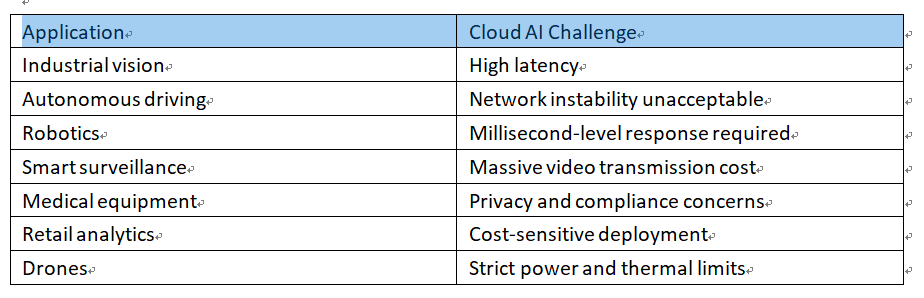
As a result, edge inference is becoming one of the most important directions in modern AI infrastructure.
Increasingly, industry research shows that the real bottleneck of edge AI is not simply insufficient compute power, but system efficiency itself. Key factors include:
* Memory bandwidth
* Data movement efficiency
* Compiler optimization
* Power efficiency
* Real-world inference utilization
The Limitations of Traditional GPU-Based Edge AI
Today’s edge AI market still relies heavily on:
* GPU platforms such as Jetson
* General-purpose NPUs
* FPGA accelerators
But GPUs were originally designed for:
* Graphics rendering
* HPC computing
* AI training
This gives them excellent flexibility, but also major drawbacks for edge deployment.
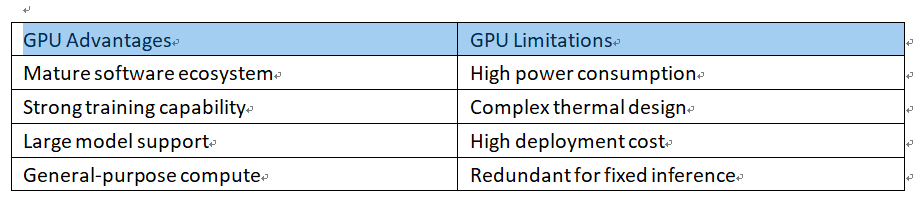
High-performance edge GPU modules often consume 30W to over 100W and require active cooling systems. This is problematic for:
* Battery-powered devices
* Smart cameras
* Compact robots
* Industrial terminals
In many edge AI environments, power and thermal constraints matter more than raw computing power.
The Rise of AI ASIC and Dataflow Architectures
One of the biggest changes in edge AI is the transition toward dedicated AI ASIC architectures.
Unlike general-purpose GPUs, AI ASICs are designed specifically for neural network inference. Their focus is not maximum theoretical performance, but maximum effective inference performance per watt.
This is where companies like Hailo and DEEPX stand out.
Hailo-8: Optimized for Efficient Data Movement
The Hailo-8 accelerator represents a classic example of a dataflow architecture optimized for edge inference.
Rather than building a smaller GPU, Hailo redesigned the chip around neural network data movement itself.
Key specifications include:
* 26 TOPS performance
* Approximately 2.5W power consumption
* Fully integrated on-chip memory
* No external DRAM requirement
This architectural decision is extremely important.
Traditional GPUs and NPUs rely heavily on external memory such as GDDR, LPDDR, or HBM. External DRAM increases:
* Power consumption
* Latency
* PCB complexity
* Thermal pressure
* BOM cost
Hailo instead minimizes data movement by keeping workloads inside the chip as much as possible. The result is significantly improved energy efficiency.
This makes Hailo especially suitable for:
* Smart cameras
* Industrial vision
* Edge servers
* Robotics vision
* Drones
* Smart transportation systems
Its value lies not necessarily in absolute peak performance, but in deployment scalability under strict power limits.
Why DEEPX Represents a New Direction for Edge AI
Compared with Hailo, DEEPX pushes even further toward ultra-low-power AI acceleration and localized generative AI.
The DEEPX DX-M1M delivers:
* 25 TOPS INT8 performance
* Approximately 3W power consumption
* Industry-leading 8.3 TOPS per watt efficiency
The module integrates onboard LPDDR4x memory and supports PCIe Gen3 connectivity for flexible integration into both x86 and Arm systems.
Unlike GPUs, DEEPX does not compete in:
* FP32 computing
* General-purpose acceleration
* Large-scale training
Instead, it focuses entirely on optimized inference using:
* INT8 acceleration
* Dataflow optimization
* Model quantization
* SRAM utilization
* Compiler-level optimization
Its core objective is simple: Bring AI into devices that must run continuously in the real world.
This includes:
* Home robots
* Factory automation
* Autonomous systems
* AI cameras
* Smart appliances
Giada LM2-100: Ready-to-Deploy Edge AI Acceleration
Building on the DEEPX architecture, Giada introduced the LM2-100 M.2 AI Accelerator Module for industrial and embedded AI deployment.
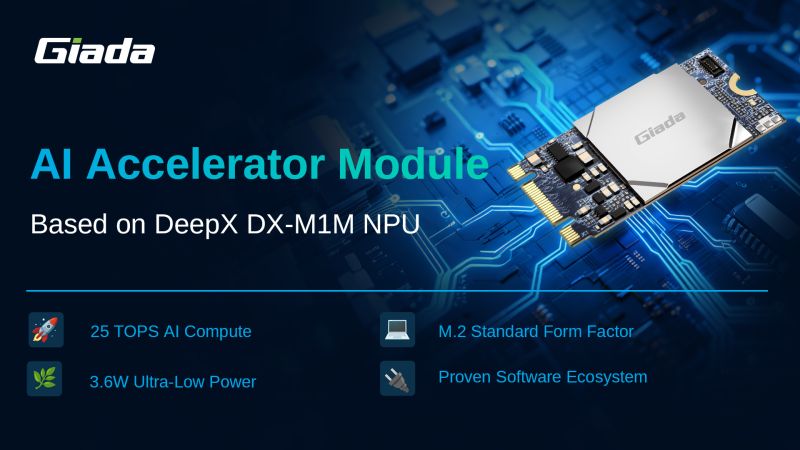
The LM2-100 provides:
* 25 TOPS AI computing performance
* Typical power consumption of only 3.6W
* Standard M.2 2280 form factor
* PCIe Gen3 x2 interface
* Industrial operating temperature support
The module is optimized for:
* Computer vision
* Smart automation
* Real-time video analytics
* Edge AI inference
Because it integrates easily into existing embedded systems, developers can add AI acceleration without redesigning hardware platforms.
The Future of Edge AI Hardware
A key industry conclusion is becoming increasingly clear:
Future AI hardware will not be dominated by a single architecture.
Different workloads will require different computing approaches:
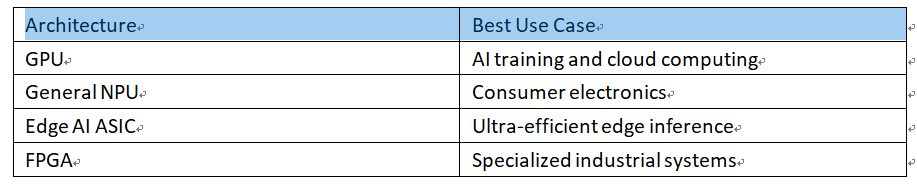
Over the next five years, the edge AI market will likely focus less on peak TOPS and more on:
* Performance per watt
* Software ecosystem maturity
* Total deployment cost
* Ease of integration
At the same time, robotics and physical AI may become the largest long-term growth market for edge AI accelerators.
Unlike cloud AI, robots require:
* Real-time vision
* Sensor fusion
* Continuous operation
* Low power consumption
* Local decision-making
This creates enormous demand for low-power edge AI chips.
Conclusion
Companies such as Hailo and DEEPX are not trying to replace NVIDIA GPUs in cloud AI training. Instead, they are opening entirely new markets that traditional high-power GPUs cannot efficiently serve.
The future of AI will likely combine:
* Cloud AI for large-scale training
* Edge AI for real-time local inference
As AI becomes embedded into cameras, robots, industrial systems, vehicles, and smart infrastructure, low-power AI ASIC accelerators may become as widespread as microcontrollers are today.
For enterprises building modern edge AI systems, choosing the right accelerator is no longer only about compute performance — it is about finding the optimal balance between power efficiency, deployment flexibility, scalability, and long-term operational cost.



 Inquiry
 Download
 Technical Support
 RMA
RMA Events