This shift has created a new category of devices: the AI PC.
But what exactly is an AI PC? How is it different from a traditional PC? And do you really need one?
The key difference is simple: an AI PC is designed to process AI workloads efficiently, including AI tasks that can run locally on the device.
An AI PC is a computer equipped with hardware specifically designed to accelerate artificial intelligence workloads.
Unlike a traditional PC that relies mainly on a CPU for general-purpose computing, an AI PC typically combines three types of processing resources:
CPU (Central Processing Unit): Handles general-purpose computing and system tasks.
GPU (Graphics Processing Unit): Provides highly parallel processing for graphics and demanding AI workloads.
NPU (Neural Processing Unit): Specializes in efficient AI inference and neural-network operations.
The combination of CPU, GPU, and NPU allows an AI PC to assign different workloads to the processor best suited for the task.
An important feature of many modern AI PCs is local AI processing, which allows supported AI workloads to run directly on the computer rather than relying entirely on cloud-based AI services.
The primary difference between an AI PC and a traditional PC is its ability to efficiently handle modern AI workloads.
A conventional PC can run AI applications using its CPU or GPU. However, continuously processing AI workloads can consume significant computing resources and power.
An AI PC adds dedicated AI acceleration, particularly through an NPU, to improve the efficiency of supported workloads.
| Feature | Traditional PC | AI PC |
|---|---|---|
| General computing | CPU | CPU |
| Graphics processing | GPU | GPU |
| Dedicated AI acceleration | Usually limited | NPU and/or AI-optimized GPU |
| Local AI inference | Possible | Designed for efficient local AI |
| AI workload efficiency | Depends on CPU/GPU | Optimized for supported AI workloads |
An AI PC therefore does not replace the CPU or GPU. Instead, it creates a more balanced computing architecture in which CPU, GPU, and NPU work together.
Many AI services currently rely on cloud computing. Data is sent to remote servers, processed by powerful infrastructure, and the results are returned to the user.
Cloud AI remains valuable, particularly for large AI models and computationally intensive workloads. However, local AI processing offers several advantages for supported applications.
When AI inference takes place locally, data does not always need to travel to a remote server and back. This can reduce response times for applications that require real-time processing.
Local AI can keep certain sensitive data on the device. This can be particularly important for businesses working with confidential documents, images, customer information, or industrial data.
Running suitable AI workloads locally can reduce reliance on continuous cloud connectivity and may help lower recurring cloud processing costs.
Some AI applications can continue operating locally when an internet connection is unavailable or unreliable, depending on the model and software implementation.
For supported AI inference workloads, an NPU can perform certain calculations more efficiently than relying exclusively on a CPU.
AI PCs can support a growing range of applications across business and consumer environments.
AI PCs can support local AI assistants, document summarization, transcription, translation, content generation, and other productivity tools.
AI acceleration can be used for background removal, image enhancement, video effects, object recognition, and other creative workflows.
Retail, security, manufacturing, and smart-city applications can use local AI for object detection, people counting, image classification, and visual inspection.
AI PCs can support real-time speech recognition, translation, noise reduction, background effects, and other intelligent communication features.
AI PCs and compact edge computers can bring AI inference closer to where data is generated. This is useful when applications require low latency, local decision-making, or greater control over data.
The NPU is one of the most important components of modern AI PCs.
An NPU is a processor specifically optimized for neural-network operations and AI inference. It is designed to handle supported AI workloads efficiently while allowing the CPU and GPU to focus on other tasks.
For example, an AI PC might use:
CPU → operating system and general applications
GPU → graphics, video, and demanding parallel workloads
NPU → supported AI inference and neural-network tasks
This heterogeneous architecture is one of the defining characteristics of modern AI computing.
However, not every AI application automatically runs on the NPU. Software and AI frameworks must support the relevant hardware acceleration technology. Therefore, when selecting an AI PC, it is important to consider both the hardware specifications and software compatibility.
Choosing an AI PC should start with your application requirements rather than simply looking at the TOPS number.
Consider the following factors:
1. AI workload: What AI models and applications will you run?
2. NPU performance: Does the system provide sufficient AI acceleration for your intended workloads?
3. CPU and GPU performance: AI PCs still need strong general-purpose and graphics performance.
4. Software compatibility: Check whether your applications and AI frameworks can take advantage of the available NPU or GPU acceleration.
5. Connectivity and expansion: For commercial and edge applications, consider display outputs, networking, storage, USB, wireless connectivity, and expansion options.
6. Power and thermal requirements: Compact AI PCs may need to balance performance with power consumption and heat dissipation.
Giada develops compact computing platforms designed for applications ranging from commercial computing and digital signage to edge AI.
The Giada N601 AI PC is powered by Intel Core Ultra processors with integrated AI acceleration and delivers up to 34 TOPS of AI computing performance. It is designed to support AI-assisted productivity, image and video processing, creative applications, and other local AI workloads.
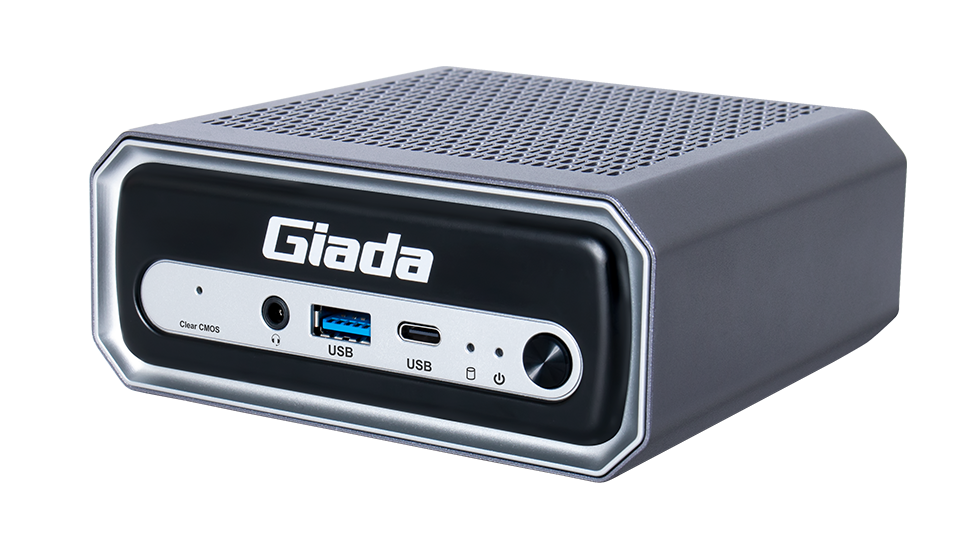
For embedded and edge AI applications, Giada also provides platforms based on processors with integrated NPUs, enabling AI inference in compact and power-efficient systems.
These platforms can help solution integrators build AI-enabled systems without relying entirely on cloud computing.
AI PCs are part of a broader transition from cloud-only AI toward hybrid and distributed AI computing.
Cloud infrastructure will continue to provide the computing power required by large AI models and complex workloads. At the same time, local AI processing will become increasingly important for applications that require low latency, privacy, offline operation, or real-time decision-making.
As AI capabilities move closer to the endpoint, PCs, embedded computers, digital signage players, and edge devices will increasingly become intelligent computing platforms rather than simple data terminals.
An AI PC is a computer equipped with hardware designed to accelerate AI workloads, typically combining a CPU, GPU, and dedicated AI acceleration such as an NPU.
An AI PC is specifically designed to process supported AI workloads more efficiently, particularly through dedicated AI acceleration and local AI inference capabilities.
Not necessarily. However, an NPU can provide efficient acceleration for supported AI inference workloads and is an important component of many modern AI PC platforms.
Yes. Many supported AI workloads can run locally, although whether an application can operate completely offline depends on its software, AI model, and hardware requirements.
If you regularly use AI applications, local AI inference, computer vision, content creation, or AI-assisted productivity tools, an AI PC can provide meaningful benefits. For basic office and web workloads, a conventional PC may still be sufficient.
The value of an AI PC comes from its ability to bring efficient AI processing closer to the user.
By combining CPU, GPU, and NPU technologies, AI PCs can provide a flexible platform for local AI inference, intelligent applications, and next-generation computing.
For businesses and solution integrators, the question is no longer simply whether AI will become part of computing, but where AI should be processed and which hardware architecture best fits the application.
With its AI PC and edge computing solutions, Giada is helping businesses explore practical ways to bring AI closer to the endpoint—efficiently, securely, and intelligently.


 Inquiry
 Download
 Technical Support
 RMA
 Events