As AI becomes part of everyday business operations, organizations are looking for ways to move intelligence closer to users, devices, and machines. Instead of sending every piece of data to a remote cloud server, Edge AI computing enables devices to analyze and respond to data locally.
This shift is particularly important for applications that require real-time processing, reliable connectivity, privacy, or continuous operation. From smart retail and industrial automation to computer vision and intelligent transportation, Edge AI PCs are becoming an important computing platform for the next generation of intelligent applications.
An Edge AI PC is a computer designed to run artificial intelligence workloads locally, close to where data is generated.
Unlike traditional PCs that may rely on cloud platforms for demanding AI processing, an Edge AI PC combines a CPU with dedicated AI acceleration technologies such as an NPU (Neural Processing Unit), GPU, or other AI accelerator.
This architecture allows the system to perform tasks such as:
AI inference
Computer vision
Object detection
Image and video analysis
Speech recognition
Natural language processing
Predictive analytics
Generative AI workloads
The exact AI capabilities depend on the processor, accelerator, software framework, and AI model being used.
The basic principle is straightforward:
Data → Local AI Processing → Real-Time Result → Optional Cloud Synchronization
For example, a camera connected to an Edge AI PC can capture video, while the local computing system analyzes the video and identifies objects or events.
Instead of continuously sending raw video to a cloud server, the system can process the data locally and transmit only relevant results or selected information.
This approach can reduce latency, network traffic, and unnecessary data transmission.
An Edge AI PC can therefore act as an intelligent computing layer between physical devices and cloud infrastructure.
Edge AI and cloud AI are not necessarily competing technologies. In many real-world deployments, they work together.
| Feature | Edge AI PC | Cloud AI |
|---|---|---|
| Data processing | Local | Remote |
| Response time | Very low for local processing | Depends on network |
| Internet dependency | Lower | Higher |
| Data privacy | More data can remain local | Data is transmitted to cloud |
| Bandwidth requirements | Lower for local inference | Potentially higher |
| Scalability | Limited by local hardware | Highly scalable |
| Best suited for | Real-time and local workloads | Large-scale centralized workloads |
For many applications, a hybrid architecture is the most practical solution. Edge devices handle real-time inference, while cloud platforms can provide centralized storage, model management, analytics, and large-scale AI training.
Local inference eliminates much of the network round trip between a device and a remote server.
This is particularly valuable for applications such as machine vision, industrial monitoring, security analytics, and interactive systems where fast responses are important.
Sensitive information can be analyzed locally without continuously transmitting raw data to external servers.
For example, an Edge AI PC can process images or video locally and send only selected metadata or analytical results to a central platform.
This can help organizations design AI systems with stronger data-control strategies, although specific regulatory requirements still depend on the application and region.
Local AI processing can reduce the amount of data that needs to travel across a network.
This can be particularly useful in locations with limited connectivity or where sending continuous high-volume data to the cloud would be expensive.
Edge AI systems can continue performing local workloads even when network connectivity is temporarily unavailable.
For industrial, retail, transportation, and other operational environments, this can improve system resilience.
Modern processors increasingly integrate dedicated AI acceleration.
For example, an NPU can efficiently handle supported AI inference workloads while the CPU manages general-purpose computing and the GPU handles graphics or highly parallel workloads.
This heterogeneous architecture allows computing resources to be matched to different tasks.
Edge AI PCs can enable intelligent retail applications such as:
Customer traffic analysis
Computer vision
Smart kiosks
Product recognition
Digital signage analytics
Intelligent self-service systems
Local processing can help retailers analyze visual data in real time while reducing the need to transmit continuous video streams to the cloud.
Manufacturers can use Edge AI for machine vision, predictive maintenance, anomaly detection, and automated quality inspection.
For example, an AI system can analyze production-line images and identify potential defects immediately, helping manufacturers respond before defective products move further through the production process.
Edge AI provides intelligence to Industrial IoT systems by processing information from sensors, cameras, machines, and other connected devices.
Instead of simply collecting data, edge devices can interpret that data and trigger actions locally.
AI-powered video analytics can identify objects, detect specific events, and support real-time monitoring.
Processing video locally can also reduce the amount of raw footage that needs to be transferred across a network.
Edge AI can support applications such as medical imaging, patient monitoring, and intelligent medical equipment.
Healthcare deployments require particular attention to security, privacy, regulatory compliance, and system reliability.
Vehicles and transportation infrastructure generate large amounts of real-time data.
Edge AI can support applications including object detection, traffic monitoring, driver assistance, and intelligent transportation systems where rapid local processing is important.
The NPU is becoming an important component in modern AI PCs and edge computing platforms.
Unlike a CPU, which is designed for general-purpose computing, an NPU is optimized for specific AI workloads such as neural-network inference.
A typical AI PC can distribute workloads across different processing units:
CPU: General-purpose applications and system management
GPU: Graphics, visualization, and highly parallel workloads
NPU: Efficient AI inference for supported workloads
The NPU does not replace the CPU or GPU. Instead, it complements them.
For this reason, choosing an Edge AI PC should involve more than comparing TOPS. Software support, AI frameworks, memory, connectivity, thermal design, and the actual workload are equally important.
Giada has extensive experience in embedded computing and develops computing platforms for commercial, industrial, and intelligent applications.
The Giada N601 AI Mini PC is designed for applications that require compact computing combined with local AI capabilities.
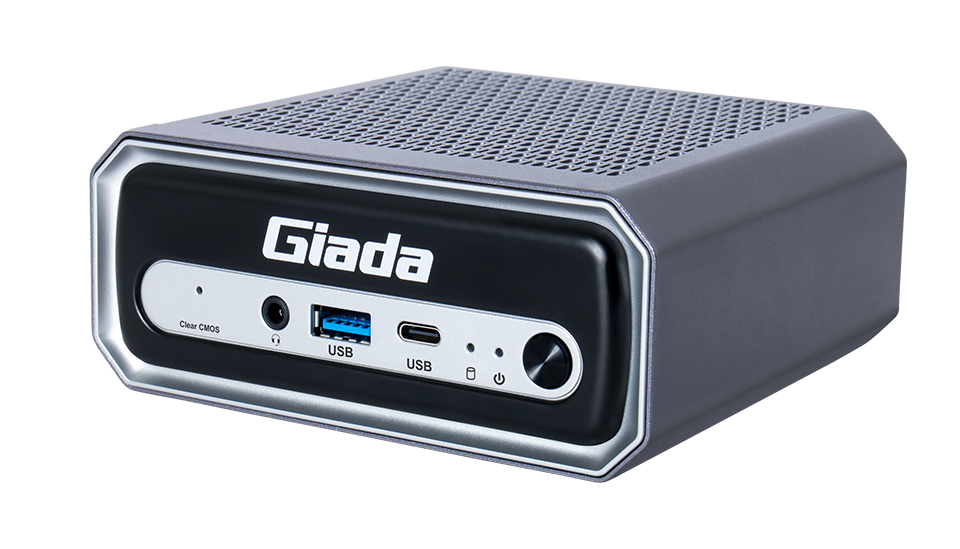
Based on Intel Core Ultra processors, the N601 integrates CPU, GPU, and NPU capabilities and delivers up to 34 TOPS of AI computing performance.
Its compact form factor makes it suitable for applications including:
Edge AI
Smart retail
Intelligent education
Digital signage
AI-assisted productivity
Computer vision
Industrial applications
By bringing AI processing closer to users and devices, the N601 can help system integrators build compact and efficient intelligent computing solutions.
Giada is also expanding its AI computing portfolio with platforms targeting different performance levels and deployment requirements, including systems designed for GPU-intensive workloads and edge AI applications.
Before selecting an Edge AI PC, consider five key factors:
1. AI workload: Determine whether the application requires computer vision, generative AI, video analytics, or other inference workloads.
2. AI accelerator: Check whether CPU, GPU, NPU, or a dedicated accelerator provides the performance required by the application.
3. Software compatibility: Confirm support for the operating system, AI frameworks, inference engines, SDKs, and application software you plan to use.
4. Connectivity and expansion: Consider Ethernet, Wi-Fi, USB, display outputs, storage, and other interfaces required by cameras, sensors, displays, or industrial equipment.
5. Deployment environment: For long-term deployments, consider size, power consumption, cooling, reliability, and maintenance requirements.
The best Edge AI PC is not necessarily the most powerful one. It is the system that provides the right balance of AI performance, power efficiency, connectivity, reliability, and software compatibility for the intended application.
An Edge AI PC is a computer that performs AI workloads locally using processors such as CPUs, GPUs, NPUs, or dedicated AI accelerators.
An AI PC is generally designed to provide local AI capabilities on a personal or business computer. An Edge AI PC emphasizes local AI processing for applications where data is generated, often involving connected devices, cameras, sensors, or industrial systems.
Not necessarily. The required hardware depends on the AI workload. Some applications benefit from an NPU, while others require stronger GPU performance or dedicated AI acceleration.
Neither is universally better. Edge AI is particularly useful for low-latency, privacy-sensitive, or connectivity-dependent applications, while cloud AI provides greater centralized scalability. Many deployments combine both approaches.
Common applications include smart retail, manufacturing, Industrial IoT, security, healthcare, transportation, digital signage, and intelligent automation.
Evaluate the AI workload, required accelerator, software compatibility, memory, connectivity, power consumption, thermal design, reliability, and future expansion requirements.
AI is becoming increasingly distributed. Instead of concentrating all intelligence in centralized data centers, computing is moving closer to users, machines, cameras, vehicles, and other connected devices.
This trend is creating new opportunities for Edge AI PCs and intelligent edge computing platforms.
As processors become more capable and AI software ecosystems continue to mature, Edge AI PCs can support increasingly sophisticated applications while reducing latency and unnecessary data transmission.
The future of AI computing is not simply about making computers more powerful. It is about making them more intelligent, responsive, efficient, and connected to the environments in which they operate.
Giada is committed to developing flexible AI computing solutions that help businesses and system integrators bring intelligence closer to the edge—from compact AI PCs to high-performance computing platforms.
Explore Giada’s AI computing solutions and discover how Edge AI can transform your next intelligent application.


 Inquiry
 Download
 Technical Support
 RMA
 Events